Finally final: embracing JEP 500
Every Java developer learns early on that a final field is assigned exactly once. Fewer learn the
footnote: unless somebody calls setAccessible(true). For almost thirty years, a final field has
been final for you and me, but not for the frameworks running our code. They could, and regularly
did, write to it whenever it suited them.
With JDK 26 that footnote is on its way out. JEP 500, Prepare to Make Final Mean Final, starts the countdown, and this article is about what that means for the code that has relied on the footnote the most: serializers.
JEP 500 in two minutes
Since JDK 26, writing a final field through deep reflection (Field::set after setAccessible(true))
still works, but the JVM prints a warning. That’s the friendly phase. The JEP is very clear that a
future release will switch the default to deny, and from then on the same call throws an
IllegalAccessException.
Two command-line options control the behaviour:
--enable-final-field-mutation=M1,M2lets the named modules (orALL-UNNAMEDfor the class path) keep mutating finals without a warning. That’s an explicit opt-in, the same idea as--add-opens.--illegal-final-field-mutation=allow|warn|debug|denydecides what happens to everybody else.warnis today’s default, anddenyis tomorrow’s.
Why bother? Because a final that can be changed behind your back is not a guarantee, it’s a
suggestion. When final really means final, you can reason about your objects with confidence, and so
can the JIT: it can treat final instance fields as constants and fold them away.
Try running your application with --illegal-final-field-mutation=deny today. Anything that breaks
would break anyway, just later and at a less convenient time.
Who should care
Most application code will never notice. People don’t usually write Field.set on a final field in
business logic, and the ones who do probably already feel bad about it.
The code that does notice is the infrastructure that builds objects behind your back: dependency injection containers, mocking libraries, and above all serializers. For decades, the standard recipe for deserialization has been:
- Allocate an empty object, ideally without running any constructor
(
Unsafe.allocateInstance,ReflectionFactory, or the way Java Object Serialization does it). - Fill in the fields one by one through reflection,
finalor not.
It’s convenient, and it has two well-known downsides. Constructors never run, so the invariants they check are never checked. And an object built from untrusted bytes with no constructor in the way is exactly the raw material of the deserialization gadget chains that kept security teams busy for the last decade. JEP 500 now takes away the second step for final fields.
The JEP does leave serializers one door open: sun.reflect.ReflectionFactory remains supported for
deserializing Serializable classes. That’s the quick fix. It also keeps constructors bypassed, works
only for Serializable classes, and ties you to an internal API in jdk.unsupported. We wanted a
proper fix instead.
What this post is about
Tentackle is an open source Java framework for multi-tier applications, and
TRIP, the Tentackle Remote Invocation Protocol, is its replacement for RMI
and Java serialization. TRIP moves real object graphs between JVMs, with identity, cycles and
polymorphism preserved: you send an Order, and the receiving side gets the same Order, with its
lines pointing back to it.
From Tentackle 25.20.1.0 on, TRIP never writes a final field. This post shows how we got there and what it took. None of it is specific to TRIP. If you maintain a serializer, a mapper or anything else that builds objects from data, think of it as a blueprint you can borrow.
The chicken and the egg
Here’s the running example: an order, its lines, and a small immutable value class.
public class Order {
  private Customer customer;
  private List<OrderLine> lines = new ArrayList<>();
}

public class OrderLine {
  private Order order;           // points back to the order: a cycle
  private String article;
  private Money price;
}

public final class Money {
  private final BigDecimal amount;
  private final String currency;

  public Money(BigDecimal amount, String currency) {
    this.amount = Objects.requireNonNull(amount);
    this.currency = Objects.requireNonNull(currency);
  }
}
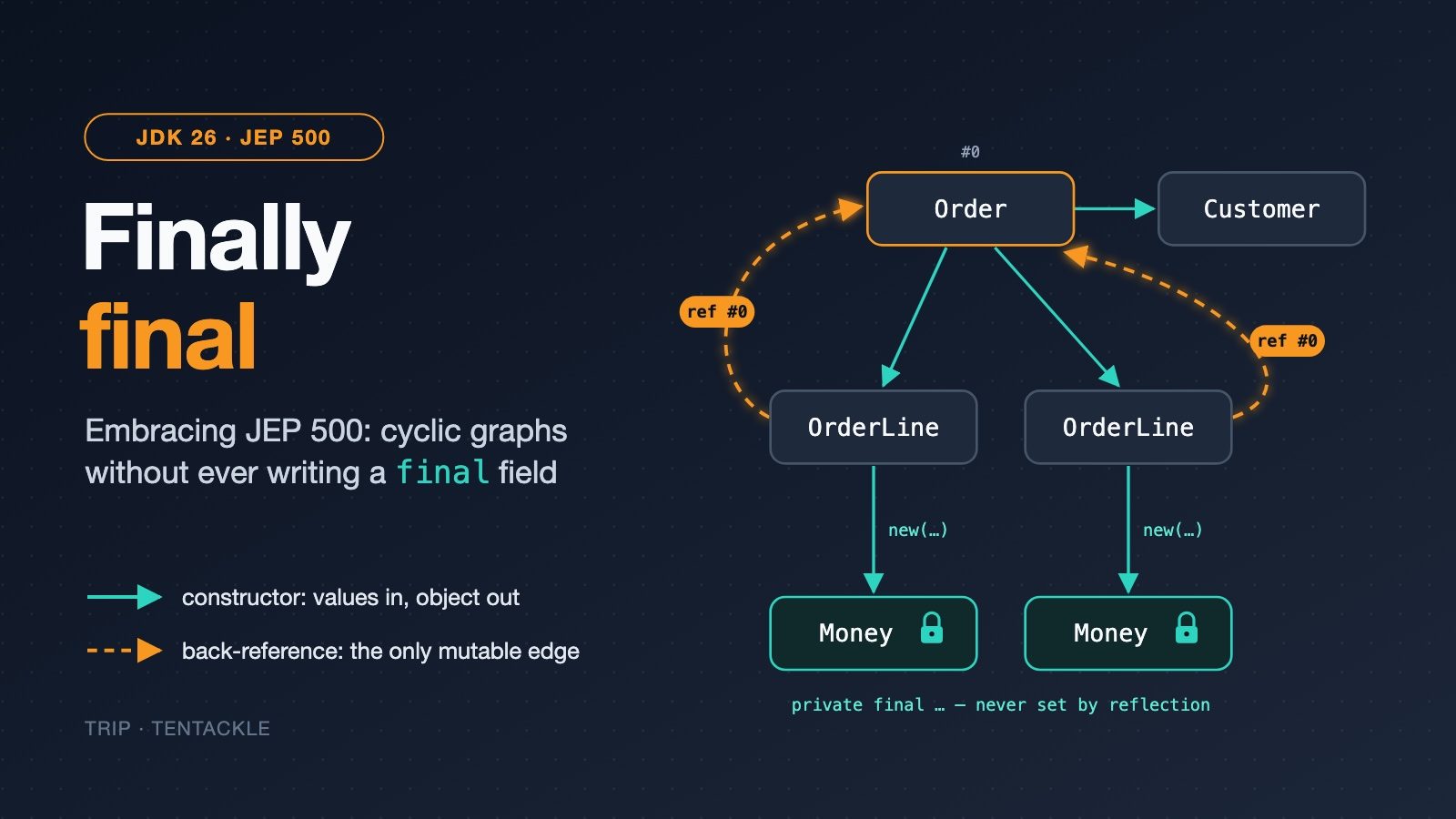
Writing this graph is easy. Remember which objects you’ve already written, and when one shows up a second time, write a short reference (“see object #0”) instead of the object itself.
Reading it back is the tricky part. When the reader arrives at OrderLine.order and finds “see object
#0”, that order must already exist, even though the reader is still busy reading the order’s lines.
The order has to be created before its contents are known. That’s why “allocate first, fill in later”
became the default: it’s the obvious answer to the chicken-and-egg problem.
But look at which field actually causes the problem: OrderLine.order, the one that closes the cycle.
Money isn’t part of any cycle. It’s a leaf. Nothing inside a Money ever needs to refer back to it,
so there’s no reason it couldn’t be built the normal way: read the amount, read the currency, call the
constructor.
That’s the whole idea of this post in one sentence: only the edges that close a cycle need to be mutable. Everything else can go through a constructor, and should.
Do it like records do
Records already show how deserialization should work. A record has a canonical constructor whose parameters the compiler knows by name and order. Java serialization reads all component values first and then calls that constructor once. If the compact constructor validates its arguments, the validation runs on every deserialization. You simply can’t materialize an invalid record from a byte stream.
Values in, object out, with the constructor as the only way in. TRIP now applies that model to every class. To deserialize an object, it picks the first of these that applies:
- A canonical constructor, if the class declares one. TRIP reads its arguments, calls it, and then reads any remaining components.
- The no-arg constructor (it doesn’t have to be public), followed by setting the remaining
non-final fields through
VarHandles. - A registered
TripInstanceCreatorfor classes that offer neither.
There’s no step four. No Unsafe, no ReflectionFactory, and no object without a constructor call.
And if a class lands in step 2 with a final field still to fill? TRIP refuses, loudly, and tells you how to fix it:
cannot deserialize final private final java.lang.String com.example.Money.currency (JEP-500):
provide a @CanonicalConstructor or @CanonicalBuilder, make the field transient, non-final or @TripIgnore,
use @TripInstanceCreatorService/@TripComponentProviderService, or enable the mutation via
-Dtentackle.trip.mutateFinalFields=true
TRIP does this no matter which --illegal-final-field-mutation mode the JVM runs in. Why wait for a
future JDK to say no when you can say it yourself today?
Classes you own: a little annotation goes a long way
For a record, the compiler answers two questions that a serializer has to answer for every other class:
- Which constructor? A class can have several.
- Which argument is which? Parameter names aren’t in the class file unless you compile with
-parameters, and Tentackle doesn’t want to force that flag on every application. Guessing by type doesn’t work either: twoStringparameters look exactly alike.
Tentackle answers them with a small family of
canonical construction annotations in
org.tentackle.reflect:
| Annotation | On | Meaning |
|---|---|---|
@CanonicalConstructor | constructor | Build the object with this one |
@CanonicalName | parameter | Which component this parameter receives |
@CanonicalField | field | This field is constructor argument number n |
@CanonicalGetter | getter | This getter supplies constructor argument number n |
@CanonicalBuilder | type or constructor | Build the object through a builder |
Money only needs two of them:
public final class Money {

  private final BigDecimal amount;
  private final String currency;

  @CanonicalConstructor
  public Money(@CanonicalName("amount") BigDecimal amount,
               @CanonicalName("currency") String currency) {
    this.amount = Objects.requireNonNull(amount);
    this.currency = Objects.requireNonNull(currency);
  }
}
On the receiving side, TRIP reads amount and currency, calls the constructor, and the null checks
run. Nobody writes a field by reflection. The constructor doesn’t have to be public, by the way: a
protected one reserved for deserialization works just as well.
Two details turned out to matter more than expected in practice:
- Superclass fields count. Canonical names are matched against the fields of the class and its
superclasses. A subclass constructor that passes its arguments to
super(...)therefore takes care of its parent’s final fields too. - A getter doesn’t need a field behind it. That’s what makes
@CanonicalGetterinteresting.java.util.Propertieskeeps its defaults in a protected field insidejava.util, which a framework can’t reach because the JDK doesn’t open its packages. Tentackle’sChainedPropertiesgets the defaults across anyway, by the front door:
public class ChainedProperties extends Properties {

  @CanonicalConstructor
  public ChainedProperties(ChainedProperties defaults) {
    super(defaults);
  }

  public ChainedProperties() {
    super();
  }

  @CanonicalGetter(ordinal = 0)
  public ChainedProperties getDefaults() {
    return (ChainedProperties) defaults;
  }
}
TRIP sends the defaults first, creates the map through the constructor, then adds the entries. The JDK’s field is never touched.
For classes built through a builder, @CanonicalBuilder names the builder class instead, and Tentackle’s
DTO generator produces that shape out of the box. Records, of course, need no annotation at all.
Classes you don’t own: a constructor from the outside
Annotations are great as long as you can edit the class. Real object graphs, however, are full of
classes you can’t touch: the JDK’s exceptions, JDBC driver exceptions, library types. You can’t put
@CanonicalConstructor on java.text.ParseException, and its private fields are out of reach anyway.
Exceptions are a good test case, because they travel a lot. A server call fails, and the client wants the real exception with its message, cause and stack trace, not a generic “something went wrong”.
TRIP solves this with two small plug-in interfaces that work as a pair.
A TripComponentProvider
decides what gets transported and how it’s read. Tentackle registers one for Throwable, which
covers the whole hierarchy. It reads the message through getMessage(), the cause through getCause()
and the stack trace through getStackTrace(). For any other field declared in a java.* class, it
looks for a public getter of the same name. That’s how ParseException.errorOffset travels as
getErrorOffset(). Public API only.
A TripInstanceCreator
decides how the object is created:
public interface TripInstanceCreator<T> {

  T create(Class<T> clazz);

  default T create(Class<T> clazz, Map<TripComponent<T, ?>, Object> values) {
    throw new TripInstantiationException(clazz, "constructor creation from deserialized values is not supported");
  }

  default boolean isCreationFromValuesSupported(Class<T> clazz) {
    return false;
  }
}
If isCreationFromValuesSupported returns true, TRIP reads all values first and hands them over. The
creator then picks a public constructor and calls it. For ParseException, the whole thing is this:
@TripInstanceCreatorService(ParseException.class)
public class ParseExceptionInstanceCreator<T extends ParseException>
       extends AbstractThrowableInstanceCreator<T> {

  @Override
  protected T create(Class<T> clazz, Values values) throws ReflectiveOperationException {
    return newInstance(clazz, new Class<?>[] { String.class, int.class },
                       values.get("message"), values.getInt("errorOffset", 0));
  }
}
The base class does the parts every throwable shares: it sets the cause if the constructor didn’t and
restores the stack trace. And because the creator is generic in T extends ParseException, it covers
subclasses too, looking up the (String, int) constructor of the actual class.
So the provider reads values through public getters, and the creator turns them back into an object
through a public constructor. Put together, they are a canonical constructor added from the
outside. No --add-opens, no private field access, and no final-field mutation.
What if no suitable constructor exists? Then the client gets a TripInstantiationException carrying
the original class name, message, cause and stack trace. One exotic exception deep in a cause chain
can’t break the whole response anymore.
Tentackle ships creators like this for the FileSystemException family, DateTimeParseException,
ParseException, URISyntaxException, PatternSyntaxException, InvalidPathException,
MissingResourceException, InvocationTargetException, and SQLException with all its subclasses.
All of them are registered by annotation and collected at build time, so nothing scans the class path at
runtime.
The price of final: cycles
So far, so good. Now back to the chicken and the egg. A constructor can only run once its arguments are known, so until then the object doesn’t exist and nothing can refer to it. We call this delayed construction. How much of an object’s content may point back to it depends on how it’s built:
| Built through | Object exists | May point back to it |
|---|---|---|
| no-arg constructor | before any component is read | every component |
@CanonicalConstructor | after the constructor arguments are read | every non-constructor component |
@CanonicalBuilder or record | after all components are read | nothing |
This isn’t a TRIP quirk, it’s simple logic: you can’t pass an object to its own constructor. Every serializer that respects a record’s canonical constructor hits the same wall as soon as a record is part of a cycle through its own components.
In practice it rarely hurts, because two different kinds of classes are involved:
- Values like
Money, validation results and exceptions are immutable, sit at the leaves of the graph, and want their invariants enforced. They get a canonical constructor or become records. - Entities like
OrderandOrderLinehave identity, change over time, and form the cycles. They keep their no-arg constructor, and the reference that closes the cycle stays non-final. It’s mutable in the domain anyway: a line can move to a different order.
So final and cycles only conflict at the edges where a cycle closes, and in a sensible domain model
those edges were never final to begin with.
A blueprint for your framework
Here’s the migration path that worked for us, generalised for any serializer or framework that builds objects:
- Make it fail first. Run your tests with
--illegal-final-field-mutation=deny, or refuse final writes in your own code as TRIP does. Every failure names a field, so the to-do list writes itself. - Give values a constructor path. Support records, and offer a way to mark a canonical constructor and map its parameters to components. Remember the superclass fields.
- Don’t transport derived state. A cached hash code or a lazily computed view becomes
transientand is recomputed on the other side. - Open a door for classes you don’t own. Let users plug in “how to read it” and “how to build it” separately, using public API only.
- Drop
finalonly on cycle edges. If an object really is referenced by its own components, it needs a no-arg constructor and a non-final back-reference. That’s the one legitimate exception. - Offer an escape hatch, with an expiry date. TRIP has
-Dtentackle.trip.mutateFinalFields=true(together with--enable-final-field-mutation=org.tentackle.core) for applications that need time to migrate. Once the JDK switches to deny, the main value of that flag will be the list of warnings it produced.
What did it take in Tentackle itself? Less than you’d think. The copy-on-write collections, the
validation results and a few exceptions got canonical constructors. A cached hash code became
transient. Four classes lost a final modifier where they genuinely needed to be filled in after
construction. The JDK exceptions got a component provider and a handful of creators. The domain
entities needed no changes at all: they are mutable by design, and they’re exactly the objects that form
the cycles.
The fact that all of this fitted into existing extension points was no accident. Every decision TRIP makes about a type can be replaced, from a single annotation up to a custom type builder. When the platform changes the rules, the fix becomes “add a few implementations” rather than “redesign the serializer”. That’s probably the most reusable lesson of the whole exercise.
Finally final
JEP 500 is often described as a restriction. For serialization, it’s more of a correction. “Allocate an
empty object and fill in the fields” was always a shortcut. It undermined final, skipped every
invariant, and made deserialization one of Java’s favourite attack surfaces.
Moving object graphs, cycles included, doesn’t need that shortcut. It needs a reference table for identity and cycles, a constructor path for every class that wants its fields final, a way to describe that path for classes you can’t change, and a design where all of this can be added without touching the serializer’s core.
Records showed us the way. We just followed them a little further. And now final is final, finally.
Further reading
- JEP 500: Prepare to Make Final Mean Final
- TRIP documentation, in particular the section on final fields and JEP 500
- Canonical construction and delayed construction in the Tentackle docs
- TRIP’s source code
on GitHub, including
FieldTripComponent, where final fields are refused - Tentackle on GitHub and the project website
Found a mistake, or something to add? Edit this page on GitHub

Harald Krake
Harald is a German software engineer and architect, author of the Tentackle framework and the code generator Wurbelizer. He can’t resist questioning the obvious way of doing things.