
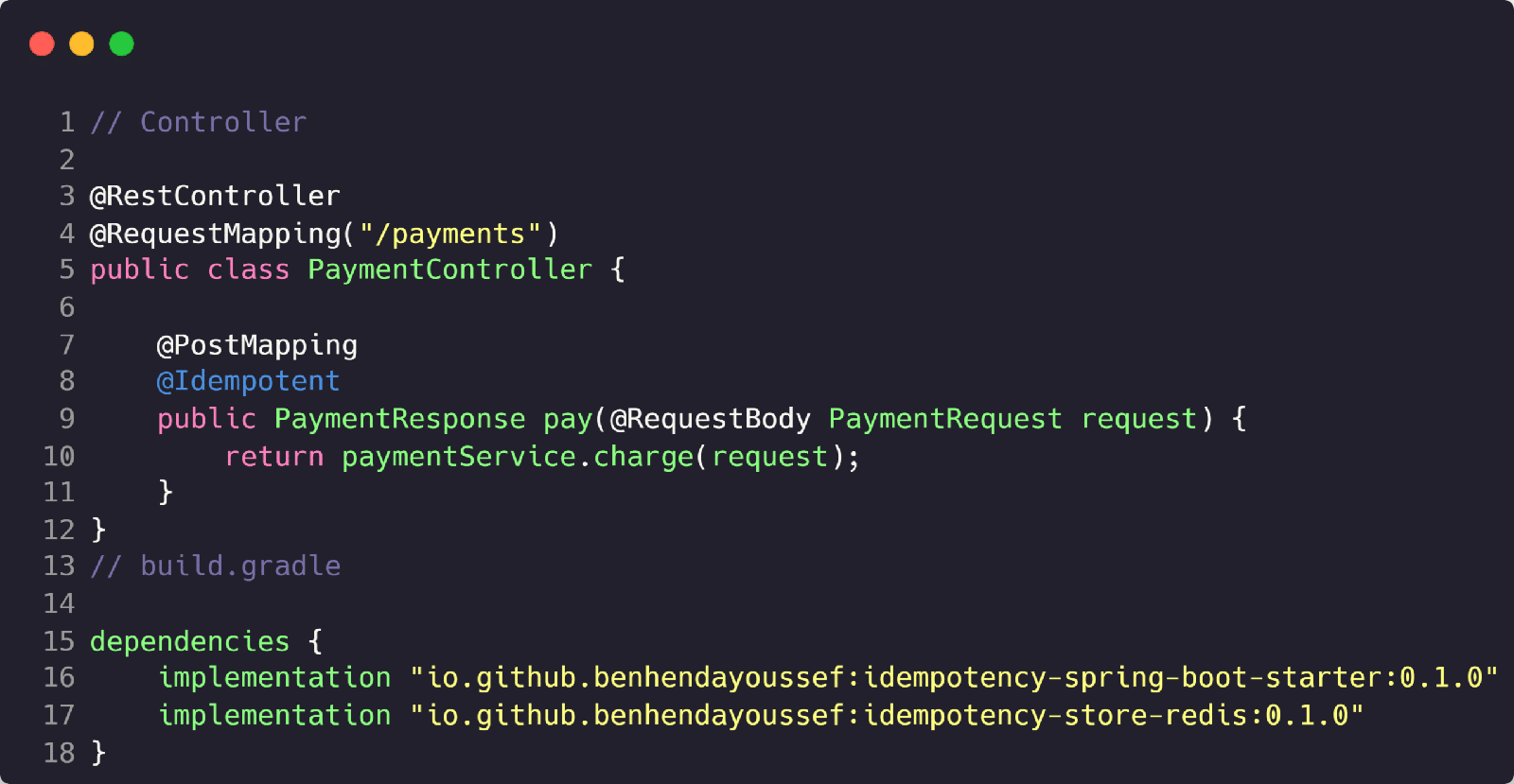
Idempotent Spring Boot: Safe REST with One Annotation
Idempotent REST Endpoints Without the Boilerplate
Stop Charging Your Users Twice: Idempotent REST Endpoints with One Annotation
The problem nobody talks about until production
A user taps “Pay.” The request times out. Their app retries. Your server charges them twice.
You didn’t write a bug. The network did. But your users don’t care about that distinction.
The idempotency problem shows up in more places than payments. A load balancer replays a timed-out request. A mobile client double-taps a submit button. A Kubernetes pod retries after a restart. From the server’s perspective, all of these look identical: a second POST that arrives after the first one already executed.
The standard fix is to have clients send an Idempotency-Key header. The server remembers what it already did. Stripe does this. PayPal does this. Most teams that need it end up writing the same boilerplate for every endpoint that matters.
I got tired of writing that boilerplate, so I built an idempotent Spring Boot starter that handles it for every endpoint at once.
What the idempotent Spring Boot starter does
idempotency-spring-boot-starter adds a single annotation:
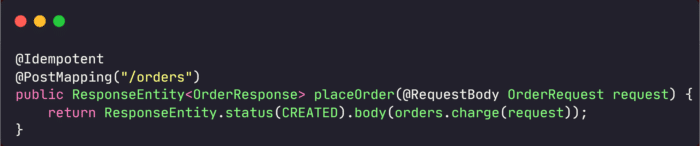
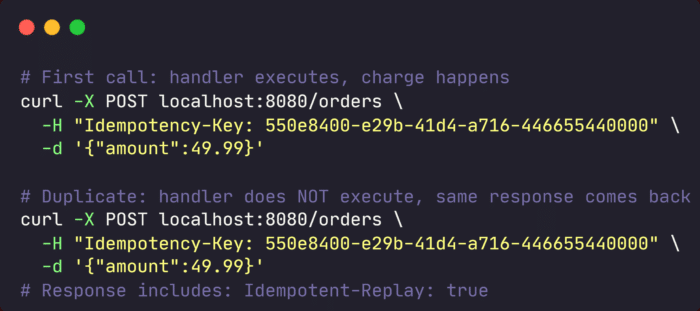
That’s it. A duplicate request carrying the same Idempotency-Key header gets the original response replayed, not a re-execution, not an error.
Two stores are available out of the box: Redis (the default when detected) and JDBC/Postgres. You swap between them with one configuration property.
What happens when things go wrong
The happy path is straightforward. The interesting design question is what to do when the handler throws.
Here is the state machine:
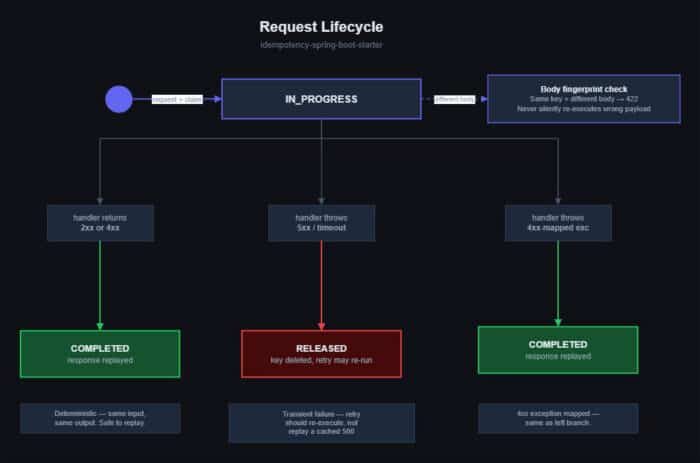
5xx failures release the key. The first request may have failed because of something transient: a database blip, a slow dependency. If we kept the key, a legitimate retry would get a cached 500 forever. That is worse than a duplicate. So we delete it and let the retry re-execute.
4xx responses are kept and replayed. A 400 Bad Request or 409 Conflict is deterministic. The same bad input produces the same bad output every time. Replaying it is correct. It also protects against race conditions where two concurrent requests both race to discover the same conflict.
This behavior is configurable via idempotency.release-on if your requirements are different.
There is also a body fingerprint check. If a client sends the same key with a different request body, that is a client bug. The library returns 422 and never silently executes the wrong payload.
Idempotent Spring Boot and Concurrent Requests: the case people forget
Sequential duplicates are the easy case. The interesting case is two identical requests arriving at the same time, before either has completed.
The claim step is atomic : a single SETNX in Redis, or an INSERT ... ON CONFLICT DO NOTHING in Postgres. One request wins the claim and runs the handler. The other sees IN_PROGRESS and waits.
By default (idempotency.on-conflict=wait), the losing request polls until the winner finishes. Then it replays the result. If polling times out, it returns 409.
You can also set on-conflict=fail_fast. This skips the polling and returns 409 immediately. Useful if your clients retry anyway and you would rather free the thread sooner.
One thing worth knowing from testing: a burst of 20 concurrent duplicates against an 8-thread pool caused unrelated endpoints’ latency to spike from sub-50ms to over a second. No requests failed. But if your thread pool is constrained and you expect frequent duplicate bursts, fail_fast is the safer choice.
The exactly-once caveat I chose to be loud about
Most libraries in this space either skip this entirely or bury it in fine print. I did not want to do that.
Both stores give you at-least-once semantics out of the box, not exactly-once.
Here is why. The AOP aspect wraps outside any @Transactional boundary on your handler. By the time the aspect calls complete(), your handler’s transaction has already committed. The completion write is a separate transaction.
This means there is a small window between your business transaction committing and the idempotency record being written. If the process crashes in that window, the key stays IN_PROGRESS until TTL expires. A retry will re-execute the handler.
For the JDBC store, exactly-once is achievable. Call IdempotencyStore.complete() from inside your own open transaction. The completion write joins that transaction and commits atomically with your business data.
But @Idempotent + @Transactional on the same method does not give you this for free. “Idempotent” and “exactly-once” are not the same claim. Getting the latter takes more than swapping in a dependency.
Quick setup for idempotent Spring Boot endpoints
Redis (recommended for most cases):

Auto-configuration kicks in when Redis is on the classpath. No extra properties required.
JDBC/Postgres:
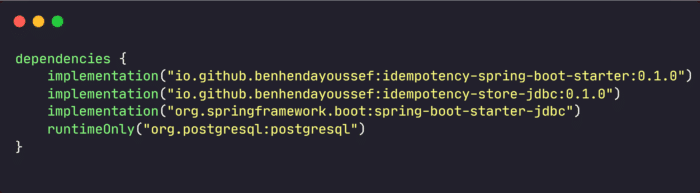
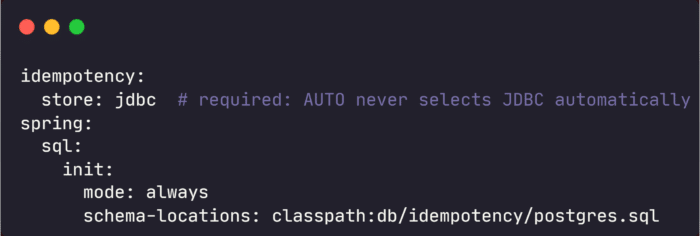
The schema file ships inside idempotency-store-jdbc. The annotation and behavior are identical regardless of which store you use.
Configuration worth knowing
Most defaults are sensible. A few properties are worth calling out:
| Property | Default | When to change it |
|---|---|---|
idempotency.require-key | false | Set to true to reject keyless requests with 400 |
idempotency.scope | global | user or tenant namespaces the key per-principal (requires Spring Security) |
idempotency.on-conflict | wait | Switch to fail_fast under a constrained thread pool |
idempotency.on-store-failure | proceed | fail returns 503 if the store is unreachable |
idempotency.release-on | five_xx,timeout | Spring needs five_xx, not 5xx |
The scope property is worth a quick note.
global means all users share the same key namespace. user namespaces keys per authenticated principal. Two different users can then use the same UUID without collision. tenant reads a claim from the JWT. You can also implement ScopeResolver yourself and register it as a @Bean.
Measured overhead
I benchmarked 200 requests with 20 warmup iterations against real Redis and Postgres via Testcontainers on Docker Desktop:
- p50: around 5 to 6.4ms added latency versus an identical unannotated endpoint
- p99: up to around 40ms
- In-memory store control: around 0.5ms p50, negative p99 (within measurement noise)
The aspect’s own cost is sub-millisecond. Fingerprinting, key composition, JSON serialization: all fast. Everything else is two network round trips: claim and complete. The Docker Desktop numbers reflect container networking, not the library.
Extending it
IdempotencyStore is a four-method interface: claim, complete, release, find. Register your own as a @Bean and @ConditionalOnMissingBean means yours wins:
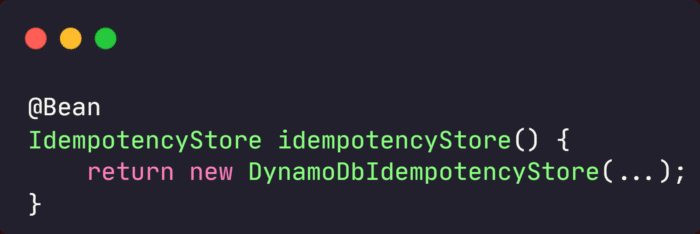
Same pattern for ScopeResolver (custom key namespacing) and IdempotencyMetrics (plug in Micrometer or anything else). There is also IdempotencyObjectMapperCustomizer. Use it to register your Jackson modules without touching your app’s own ObjectMapper.
What it deliberately does not do
Scope creep kills small libraries. These are non-goals:
- Not a retry library. It does not help you retry outbound calls.
- Not a rate limiter. Different problem, different tool.
- Not a Kafka dedup layer. Consumer idempotency is a different shape of problem.
- No WebFlux support yet. Servlet stack only in v0.1; WebFlux is on the roadmap.
- No streaming or SSE. Anything written directly to
HttpServletResponseis not captured. - Postgres only for JDBC for now; MySQL is planned.
Where to find it
Maven Central: io.github.benhendayoussef:idempotency-spring-boot-starter:0.1.0
GitHub: github.com/benhendayoussef/idempotency-spring-boot-starter
A runnable sample lives at samples/sample-orders-api. Run docker compose up -d && ./gradlew :samples:sample-orders-api:bootRun, then ./demo.sh to see the replay behavior live.
This is v0.1. I would genuinely value feedback from people who have shipped idempotent Spring Boot APIs in production, especially on the failure policy and the exactly-once limitation. Issues and PRs are very welcome.
Found a mistake, or something to add? Edit this page on GitHub







Discussions on the previous Foojay site
1 comment left on this article in 2026, kept from the previous WordPress version of foojay.io. They are an archive and are closed for replies — use the discussion above to add to the conversation.
I think this will be a good way to move on and keep developing with spring boot