New on Foojay: Television, Statistics, Java Conferences, Coming Soon and Week in Review

Foojay is more than a list of articles, and the site keeps growing. Five new pages went live in the past week: a page with Java videos, a page with the numbers behind Foojay, a map of Java conferences, a page showing which articles are coming next and a weekly review of what was published. None of them needs any manual work to stay up to date. Each one is built from data that is fetched or counted automatically, and I’ll show where that data comes from.
Foojay Television
Page: foojay.io/tv
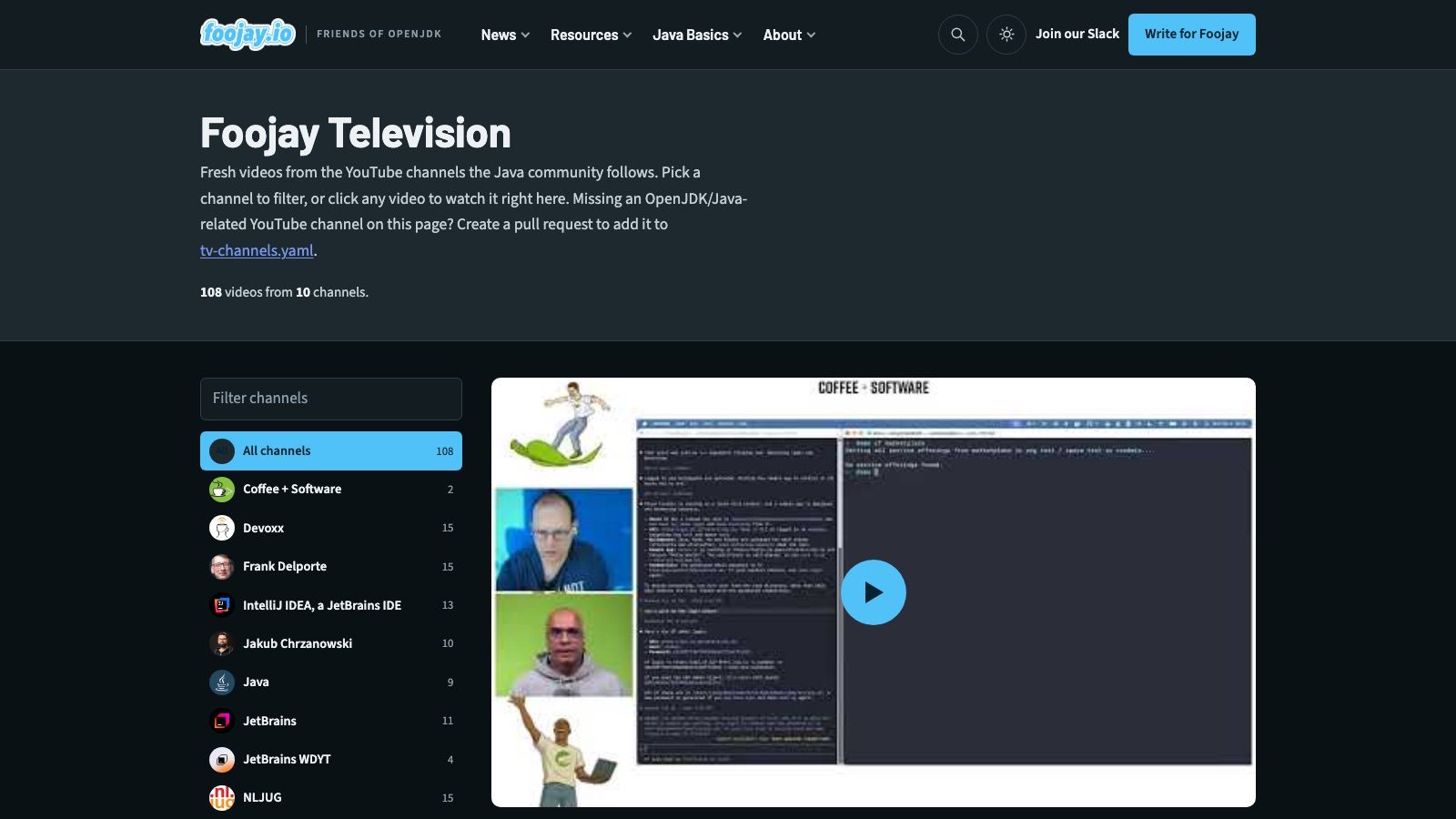
There is a lot of good Java content on YouTube, spread over many channels. Foojay Television puts the newest videos of those channels in one place.
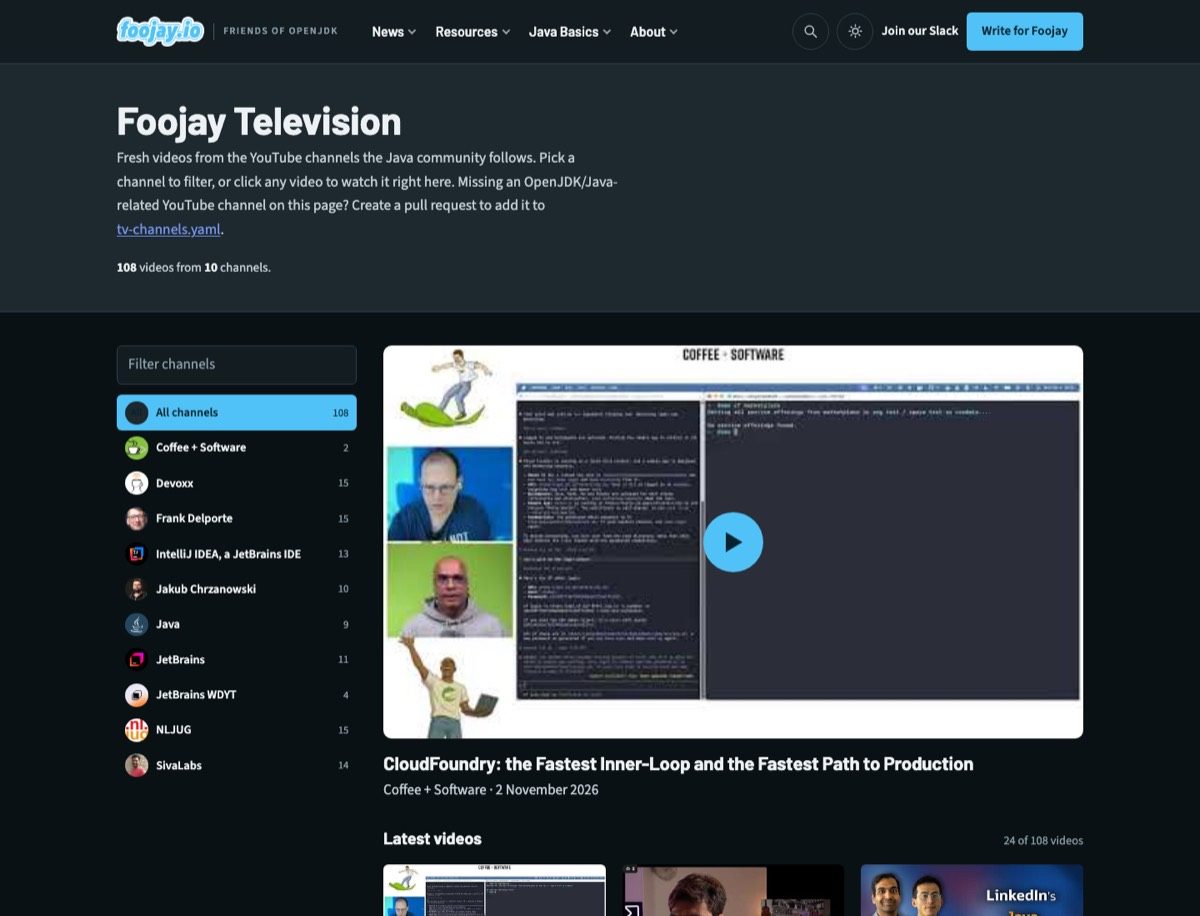
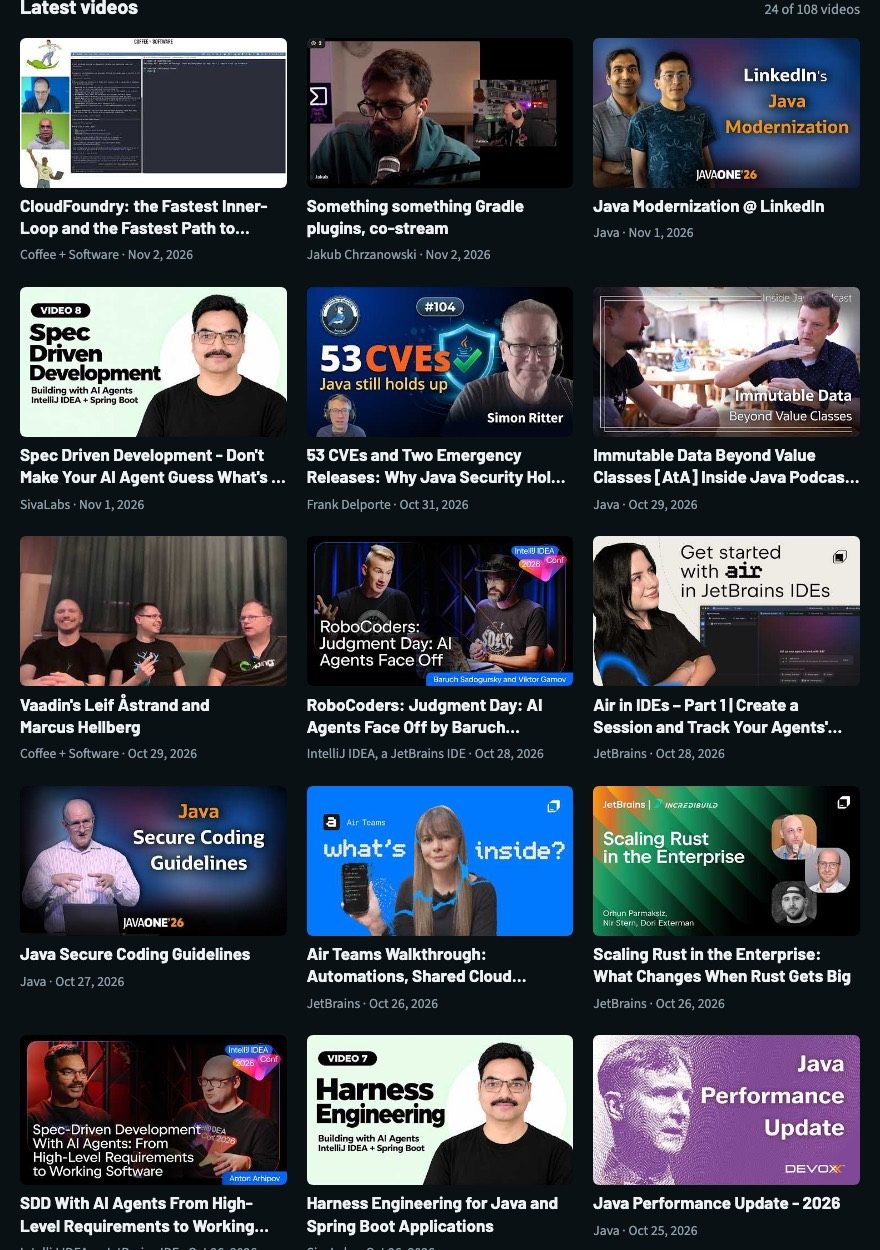
The channels are listed on the left, with a search box to filter them and the number of videos for each one. The right side shows a player with the latest video and a grid of the other videos. Pick a channel to see only its videos, or click any video to play it on the page.
The page is built to be light on tracking:
- Nothing from YouTube is loaded until you click a video. Until then, you see a thumbnail and a play button.
- After a click, the video is played through
youtube-nocookie.com. - Without JavaScript, every video is a normal link to YouTube.
YouTube Shorts are filtered out. The feed of a channel doesn’t say which videos are Shorts, so the fetch script checks every new video and skips the Shorts.
How it works:
- The channels are listed in
data/tv-channels.yaml. A YouTube handle is all you need to add one. - The script
TvVideos.javareads the public RSS feed of every YouTube channel and writes the result todata/tv-videos.json. It runs every day, and no API key is needed.
Missing an OpenJDK or Java-related YouTube channel? Add its handle to tv-channels.yaml with a pull request. The channel name, avatar and videos are fetched automatically.
Thanks to Marit van Dijk for the idea of this page.
Foojay Statistics
Page: foojay.io/statistics
How many articles did Foojay publish, how many authors write for us, and how often are the articles read? The statistics page answers these questions, and every number is counted from the site as it was built. When Foojay grows, the page grows with it.
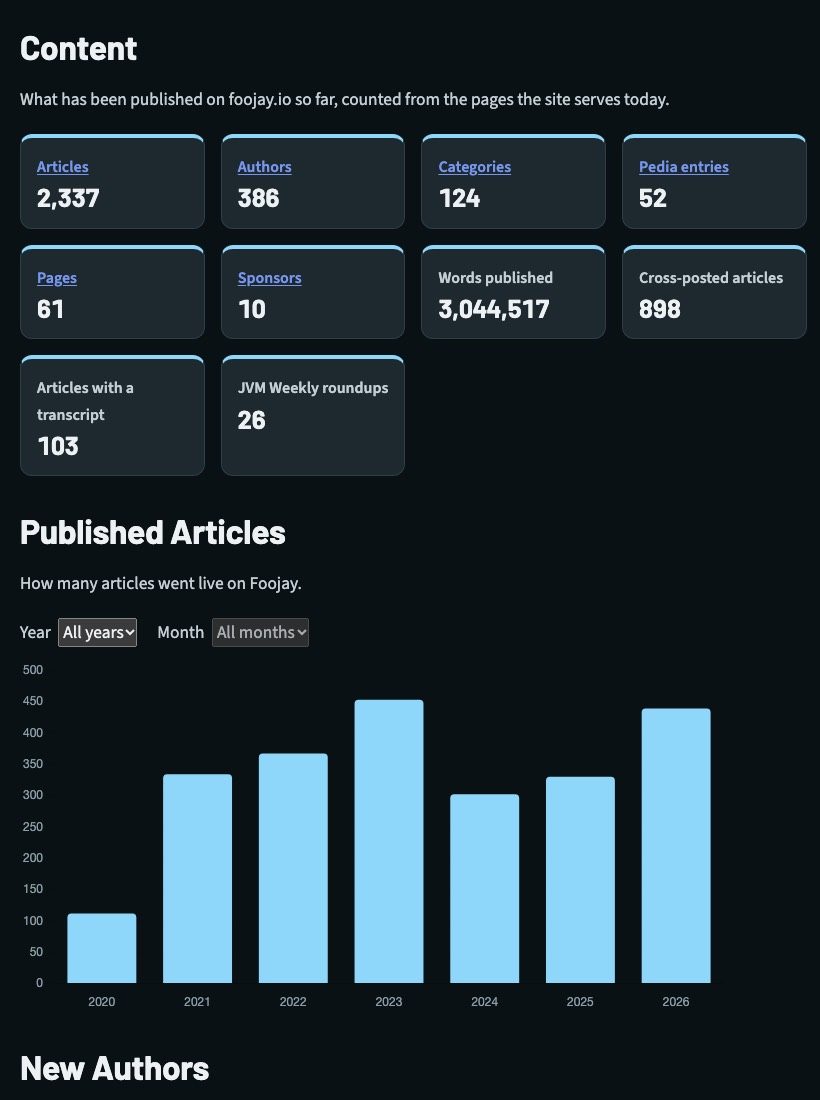
The page has five sections:
- Content: articles, authors, categories, pedia entries, pages, sponsors, published words, cross-posted articles and articles with a transcript.
- Published Articles: a chart with the articles per year, which you can narrow down by year and month.
- New Authors: a chart with how many authors published their first article on Foojay.
- Reads: how often pages have been read, including the counts carried over from the previous Foojay site.
- Community: the Java user groups, Java Champions, conferences and events listed on Foojay.
The read counts come from our own counter and not from a third-party analytics service. That way, blocked trackers don’t make the numbers too low.
How it works:
site-stats.htmlcounts everything while the site is built.ViewCounts.javarefreshesdata/views.jsonfrom the read counter, a small Cloudflare Worker.- The same numbers are available as JSON on foojay.io/stats.json, if you want to use them in your own project.
Java Conferences
Page: foojay.io/java-conferences
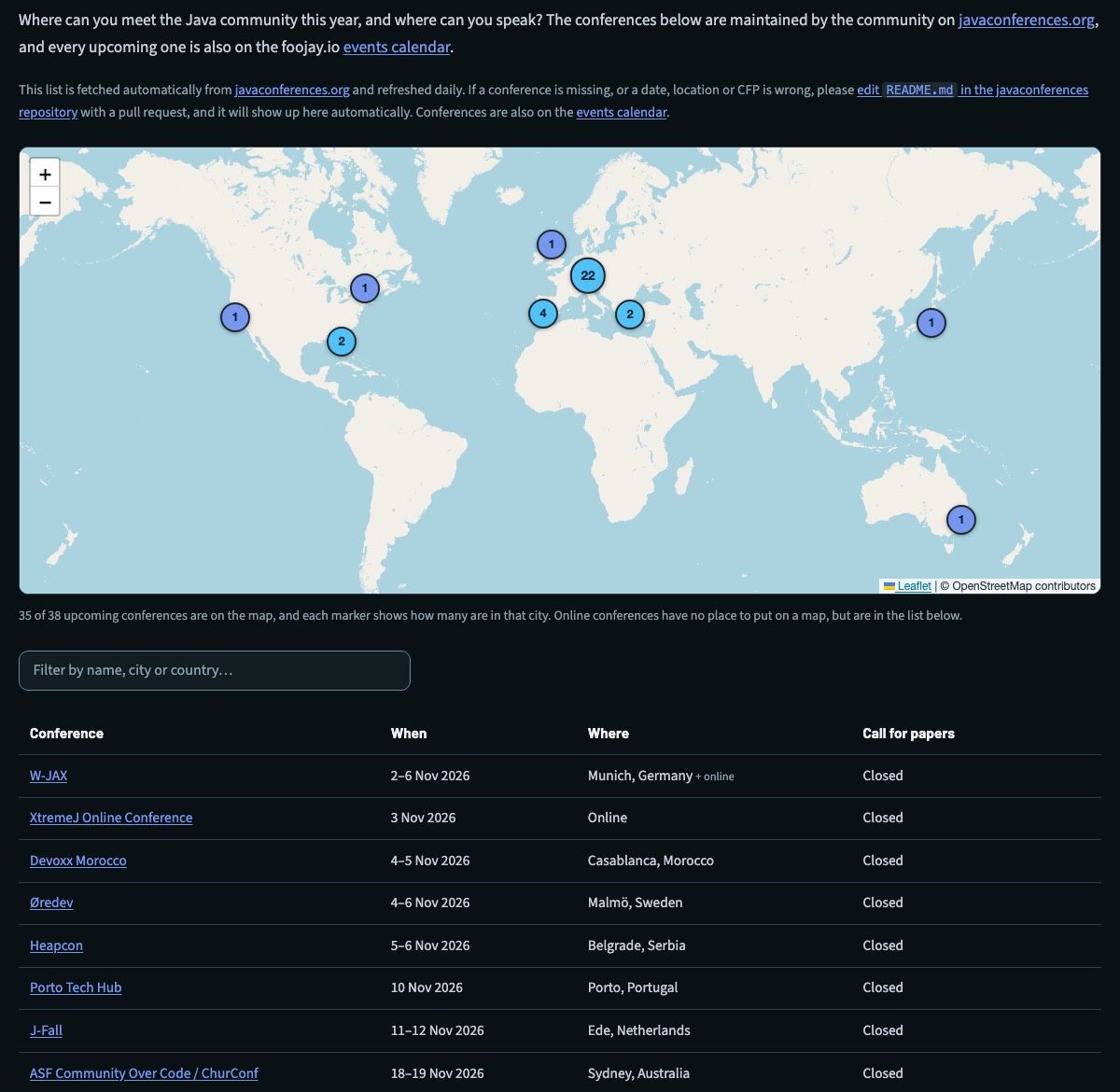
Where can you meet the Java community, and where can you speak? The Java Conferences page shows every upcoming conference on a world map, with a list below it.
Each row has the dates, the location and the status of the call for papers. Type a name, city or country in the filter box to find a conference. Online conferences have no place on the map, but they are in the list. Every upcoming conference is also added to the Foojay events calendar.
How it works:
- The list is maintained by the community on javaconferences.org, which is built from the javaconferences repository on GitHub.
JavaConferences.javareads the publishedconferences.jsonof that site every day and writesdata/java-conferences.yaml.- The dates on that site are written as free text, so the script converts them. A date it doesn’t understand is reported and skipped, never guessed.
A conference is missing, or a date or call for papers is wrong? Fix it in the README.md of the javaconferences repository with a pull request. It will show up on Foojay automatically.
Coming Soon
Page: foojay.io/today/coming-soon
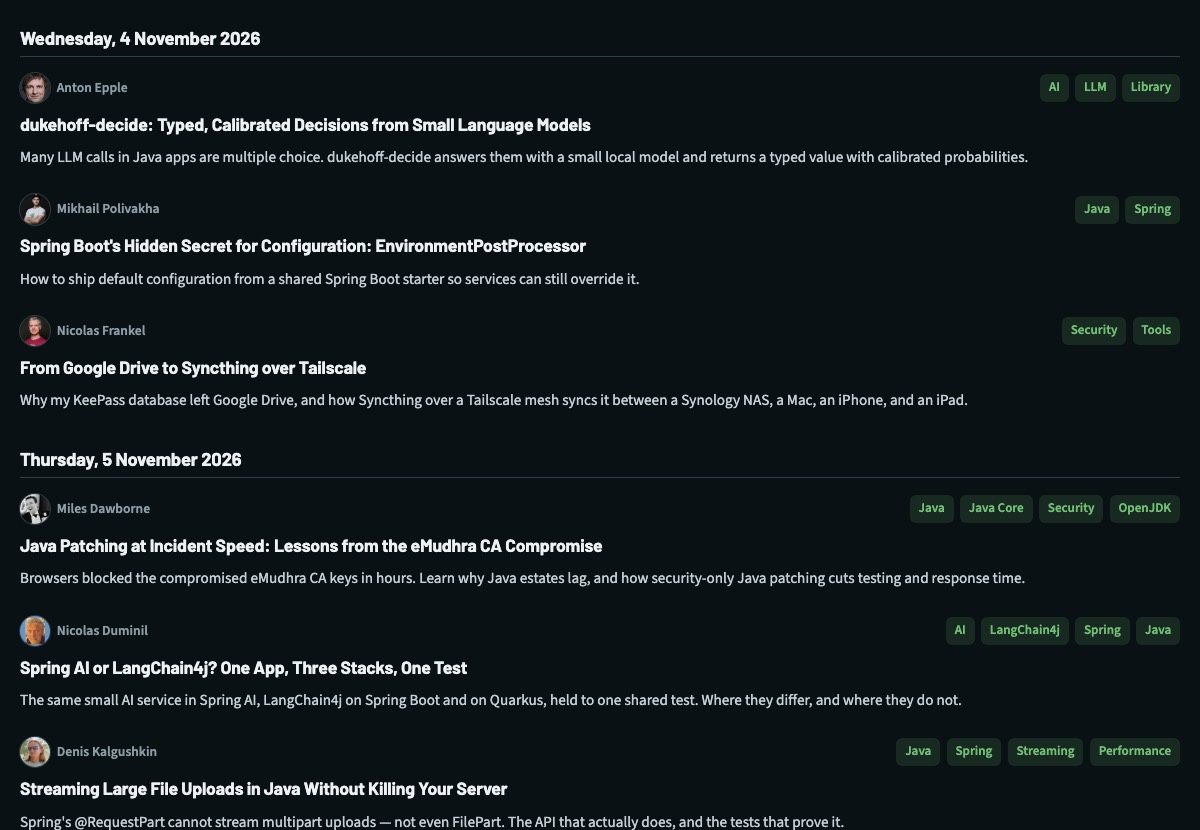
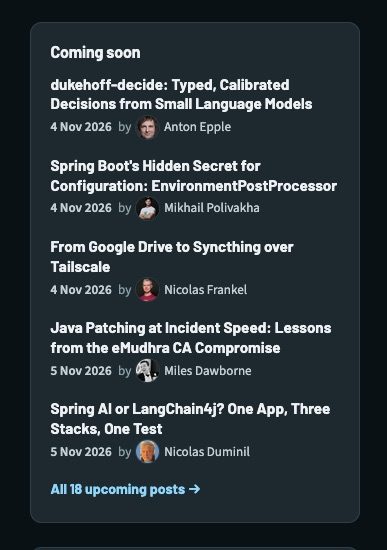
Foojay articles are scheduled in advance. A post with a date in the future doesn’t exist on the site until that day, so you couldn’t see what was coming. The Coming soon page fixes that. It lists the scheduled articles per day, with the title, the author, a short description and the categories.
The titles are not links, because the pages don’t exist yet. They go live on the date shown. A short version of this list is also on the Foojay home page.
How it works:
- Scheduled posts are not built, so no page can list them.
scheduled-posts.htmlreads them directly from the folders of the repository. - A static site only changes when it is built. The workflow
publish-scheduled.ymlchecks if an article has come due and, if so, starts the build that publishes it.
Want your article on this page? Send it in a pull request, as described in How To Submit Your Next Article On Foojay.io, and a maintainer will schedule it.
Week in Review
Page: foojay.io/today/week-review
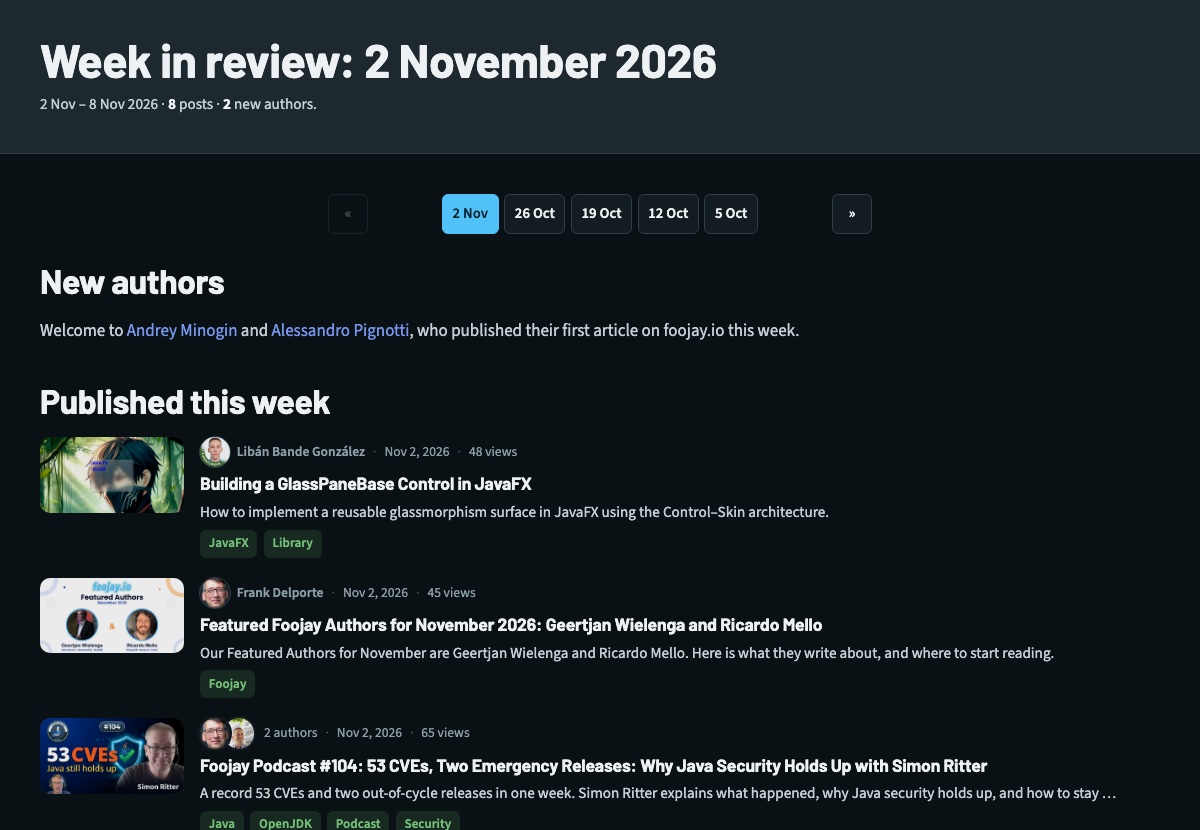
Did you miss an article last week? The Week in review page lists everything Foojay published from Monday to Sunday, as the same cards you know from the rest of the site. It opens on the latest week, and the links at the top and bottom take you to the weeks before and after it.
When an author published their first article on Foojay that week, the page says so with a short welcome. The number of posts and new authors is also shown in the header.
How it works:
- A week has no file of its own.
_content.gotmplcreates one page for every Monday-to-Sunday week that has a post, based on the folders incontent/posts/, so a new week appears by itself. week-review-body.htmlfinds the posts and the new authors of that week while the site is built.- Every Monday,
slack-weekly.ymlposts the previous week to Slack, with a link to its review page.
Feedback
All of these pages are open source, like the rest of the Foojay website. Do you have an idea to improve one of them, or a page you would like to see? Open an issue or a pull request on GitHub, or let us know on Slack.
Found a mistake, or something to add? Edit this page on GitHub

Frank Delporte
Frank Delporte is a Java Champion, Java Developer, Senior Technical Writer at Azul, Blogger, Author of "Java Programming for Raspberry Pi - A Hands-On Guide to Electronics and IoT Projects", and Open-Source Contributor for Pi4J, Lottie4J, Sheetmusic4J and …