Spring AI or LangChain4j? One App, Three Stacks, One Test

Java has quietly become a credible place to build AI applications. That raises a practical question for anyone starting out: which framework do you reach for, Spring AI or LangChain4j, and does it matter whether you run it on Spring Boot or on Quarkus?
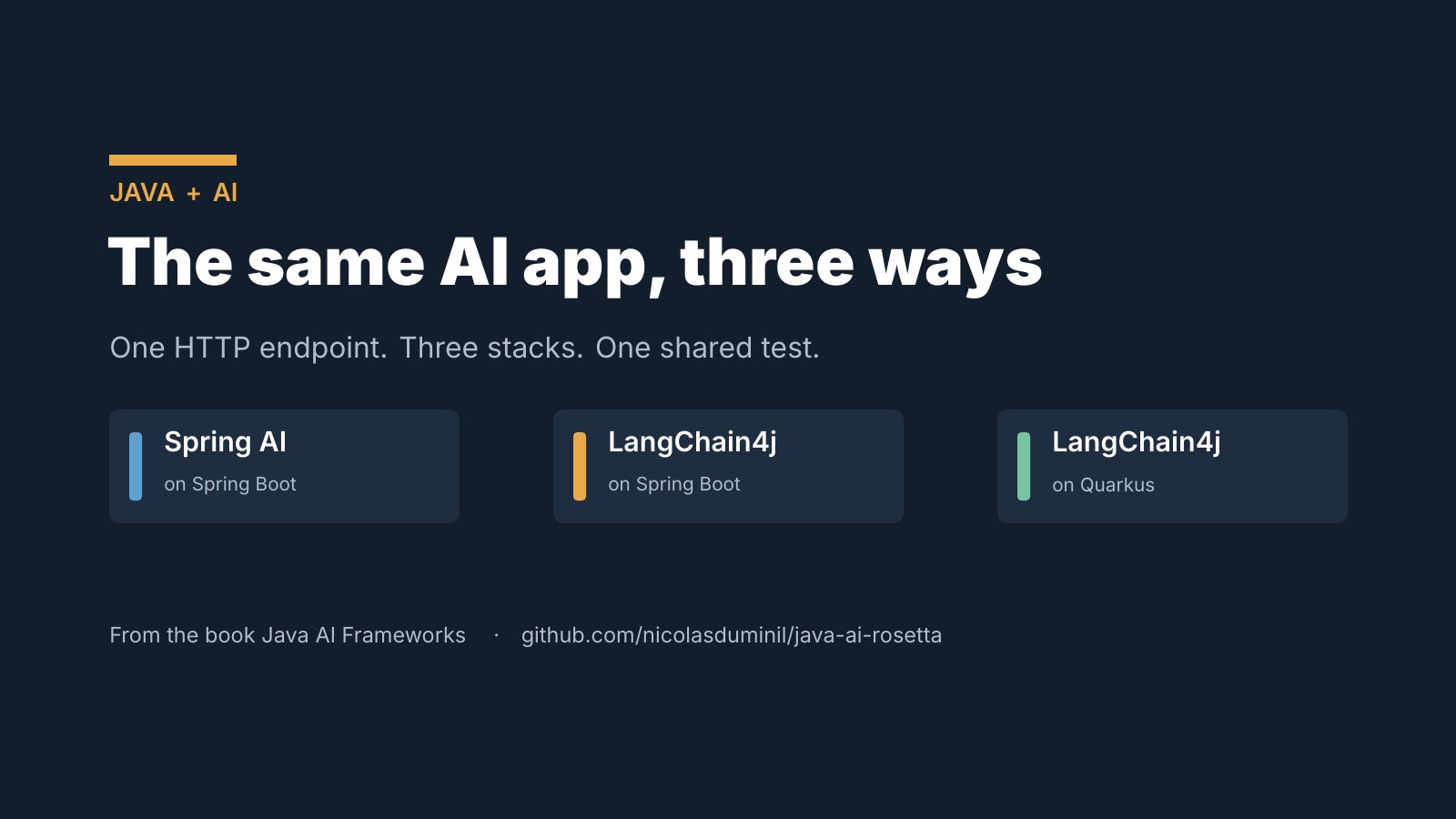
The consistent way to answer is not a feature table. It is to build the same thing on each stack and read the difference. This article does exactly that for the smallest useful AI application: one HTTP endpoint that forwards a question to a model and returns its answer. We build it three times, in Spring AI, in LangChain4j on Spring Boot, and in LangChain4j on Quarkus, and then hold all three to a single shared test.
One interface, three implementations
Everything starts from one framework-neutral contract, a plain Java interface that knows nothing about any AI library:
public interface QuestionAnsweringService {
  Answer askQuestion(Question question);
}
Question and Answer are simple records. Each stack provides only its own
implementation of this interface, and nothing framework-specific leaks into the
shared code. So the only thing that varies between the three is how each one
talks to the model.
Spring AI: a fluent ChatClient
@Service
public class SpringAiQuestionAnsweringService implements QuestionAnsweringService {

  private final ChatClient chatClient;

  public SpringAiQuestionAnsweringService(ChatClient.Builder chatClientBuilder) {
    this.chatClient = chatClientBuilder.build();
  }

  @Override
  public Answer askQuestion(Question question) {
    var answerText = chatClient.prompt()
      .user(question.question())
      .call()
      .content();
    return new Answer(answerText);
  }
}
Spring AI hands you a ChatClient.Builder, auto-configured from your properties,
and a fluent API: prompt(), user(), call(), content(). The model, its
base URL and its options are all configuration, not code.
LangChain4j: a plain ChatModel, and the same code on two runtimes
On Spring Boot:
@Service
public class LangChain4jQuestionAnsweringService implements QuestionAnsweringService {

  private final ChatModel chatModel;

  public LangChain4jQuestionAnsweringService(ChatModel chatModel) {
    this.chatModel = chatModel;
  }

  @Override
  public Answer askQuestion(Question question) {
    return new Answer(chatModel.chat(question.question()));
  }
}
LangChain4j hands you a ChatModel and a single method, chat(). There is no
builder to call: the model is injected ready to use.
Now the Quarkus version:
@ApplicationScoped
public class LangChain4jQuestionAnsweringService implements QuestionAnsweringService {

  private final ChatModel chatModel;

  public LangChain4jQuestionAnsweringService(ChatModel chatModel) {
    this.chatModel = chatModel;
  }

  @Override
  public Answer askQuestion(Question question) {
    return new Answer(chatModel.chat(question.question()));
  }
}
Look closely. The body is identical to the Spring Boot version. The only
difference is the annotation: @ApplicationScoped (CDI) instead of @Service
(Spring). Same library, same ChatModel, same chat() call. The runtime
changes, the code does not. That is precisely why it is worth running LangChain4j
on both: it isolates what the framework costs from what the runtime costs.
One test to compare them all
Three implementations are only comparable if they are held to the same standard. Each stack’s integration test extends one abstract test that talks to the running application over HTTP:
public abstract class AbstractQuestionAnsweringIT {

  protected abstract URI baseUri();

  @Test
  @DisplayName("answers a factual question")
  protected void answersAFactualQuestion() {
    ask()
      .body(new Question("What is the capital of France? Answer with the city name only."))
      .when()
      .post("/ask")
      .then()
      .statusCode(200)
      .body("answer", not(blankOrNullString()))
      .body("answer", containsStringIgnoringCase("paris"));
  }

  // ... plus: rejects a blank question (400), rejects a malformed payload (400)

  private RequestSpecification ask() {
    return given().baseUri(baseUri().toString()).contentType(ContentType.JSON);
  }
}
Two things matter here. First, the suite talks HTTP with REST Assured, never an in-process API, so the same test class can hold a Spring Boot application and a Quarkus application to the same standard: a subclass supplies only its base URI. Second, the assertion is semantic, not exact-string. It checks that the answer contains “paris”, case-insensitively, because LLM output is non-deterministic even at temperature zero. Asserting on a literal completion would make the test lie.
The tests run against a local model in an Ollama container, started with Testcontainers, so there is no API key, no per-run cost, and the whole comparison is reproducible in CI.
What the comparison reveals
The three stacks are not the same size and do not start at the same speed. Counting only non-blank, non-comment lines of production Java:
| Spring AI | LangChain4j / Boot | LangChain4j / Quarkus | |
|---|---|---|---|
| Production Java (LOC) | 48 | 47 | 39 |
Files in src/main/java | 3 | 3 | 2 |
| Resolved runtime jars | 106 | 49 | 142 |
| Startup, JVM mode | 1.74 s | 2.69 s | 0.66 s |
The startup figures are medians of a handful of runs on a single machine, with the Ollama container already up so that only application boot is inside the window: they are indicative, not benchmarks. And the jar counts do not mean Quarkus is three times heavier than LangChain4j on Boot; it simply splits its runtime into many small artifacts. A fair comparison shows that Spring AI brings 106 jars while LangChain4j brings only 49 on the same runtime. That’s because Spring AI brings a JSON-schema generator, a tokenizer and Reactor along with it, none of which this use case touches.
Even hedged this way, the shape is clear: Quarkus produces the smallest module and starts fastest, Spring AI is compact in code but the heaviest in dependencies, and LangChain4j on Boot sits close to Spring AI, the same three files with a few extra jars for its starter.
Qualitatively, the differences are small but relevant:
- Spring AI leads with a fluent, builder-based
ChatClient, and configuration drives the model. - LangChain4j leads with a single
ChatModel.chat()call, and the injected model is the whole surface. - Between Spring Boot and Quarkus, the LangChain4j code is identical except for the dependency-injection annotation, which tells you the runtime is the variable, not the library.
None of this is a verdict. The interesting output of a comparison like this is not a winner, it is the diff, and the diff is what tells you which framework fits the way your team already thinks.
Where this goes next
This is the smallest use case. The same method, build once per stack and grade with one shared test, carries all the way up: retrieval-augmented generation, conversational memory, tool calling, the Model Context Protocol, observability, security, and agents. Each one adds a capability and shows where the three stacks converge and where they diverge.
If you want the full treatment, it is the subject of my book, Java AI Frameworks, available on Leanpub with a free sample of the first two chapters.
Found a mistake, or something to add? Edit this page on GitHub

Nicolas Duminil
I’m a “silver” software architect and developer writing open source software for fun. I’m a contributor to several open-source projects like Apache Camel, Wildfly, Drools and others. I was in charge of dozens of large and complex projects across European …