

Building Systems That Know Why They Exist ~ When Data, Logic, and Intent Finally Align
- December 04, 2025
- 3 min read
Every software system begins with intent. A human decision. A statement of what should exist, how it should behave, and why it matters. But somewhere along the way, that intent dies. It’s decomposed into documentation, user stories, and scattered logic. It becomes a shadow of itself fragmented across layers of code, processes, and people who no longer remember what it was meant to achieve.
We’ve automated infrastructure. We’ve scripted configurations. We’ve even made AI write code for us. But we’ve never automated understanding. Our systems execute brilliantly yet comprehend nothing. They operate without memory of purpose. They run, but they do not know why.
This is the gap that Requirements-as-Code (RaC) exists to close. It’s not a tool or a framework. It’s an engineering discipline an architectural shift that treats requirements, business rules, and behavioral constraints as executable data models, not static documentation. Under RaC, requirements don’t describe software they are the software. They exist as structured data, versioned, queryable, interpretable at runtime, and observable across the system lifecycle.
In a RaC environment, logic isn’t buried inside code. It’s stored as intent. The system no longer executes a developer’s assumption; it interprets a documented purpose. Each requirement becomes a living object linked to context, constraints, and dependencies. Together they form a semantic graph of meaning, a cognitive skeleton that defines what the system knows about itself.
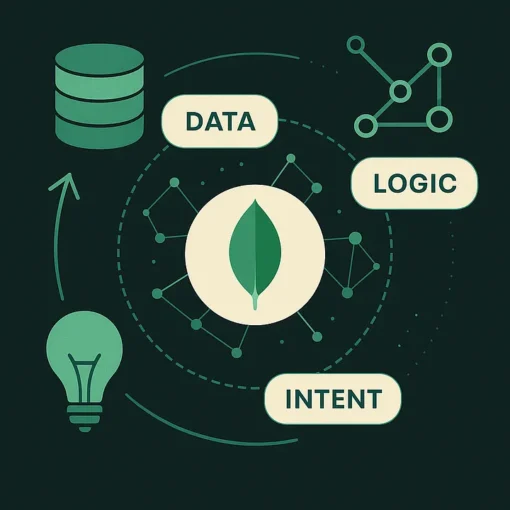
MongoDB becomes the natural substrate for this idea. Its document model mirrors the structure of thought nested, relational, self-descriptive. Each requirement can be stored as a document; relationships emerge through references and embedded structures; versioning and lineage form the backbone of traceability. Change Streams act as the system’s nervous system, broadcasting intent mutations as real-time events. Vector Search provides semantic proximity linking related requirements and behaviors into conceptual neighborhoods. Queryable Encryption ensures that comprehension does not compromise confidentiality. In this architecture, MongoDB stops being a persistence layer. It becomes a substrate of cognition, the place where data, logic, and intent converge.
A RaC system operates as a semantic control loop: specification, interpretation, execution, observation, adaptation. The specification is defined as data. The interpretation layer compiles it into runtime behavior. Execution consumes it. Observation compares reality to intent. Adaptation feeds learning back into the model. The system, in effect, learns to regulate itself not only against functional expectations, but against purpose.
Generative AI made this even more necessary. When models can generate logic, schemas, and workflows, we gain speed but lose semantic safety. AI can produce code that functions yet fails to represent intent. RaC restores the missing boundary. It defines the contract of meaning between human language and machine behavior. AI becomes a companion process: a compiler of natural language into structured intent, while the RaC layer becomes the governor that validates and constrains it. Together, they enable systems that not only generate faster, but reason more safely.
The implications for engineering are profound. Behavior becomes data-driven instead of hardcoded. New rules can be introduced like new documents, not deployments. Traceability becomes intrinsic, every action traceable to its originating requirement. Failure becomes explainable, the system can articulate why something happened, not just that it did. Refactoring becomes evolutionary driven by metadata and intent, not arbitrary branching. Governance becomes continuously embedded in the same substrate that executes logic.
RaC is not a reinvention of programming. It’s a restoration of alignment between human thought and system behavior. It treats software not as an accumulation of code, but as a network of meaning. Each requirement becomes a neuron; each dependency, a synapse; each vector, a trace of memory. MongoDB provides the cognitive architecture; AI becomes the reasoning cortex; RaC is the connective tissue that allows the system to think coherently.
This evolution isn’t about speed. It’s about fidelity. It’s about reducing semantic drift the slow entropy that occurs when software stops reflecting its original design purpose. In traditional systems, requirements die after implementation. In RaC systems, they live as part of the runtime, observable, testable, and correctable. The system carries its intent forward, continuously validating that what it does remains aligned with what it was meant to do.
We often say automation made systems faster. But RaC makes them aware. It transforms architecture into dialogue. It closes the gap between what we build and what we meant to build. It’s the bridge between code and conscience, the point where a system stops merely executing, and starts reasoning.
Infrastructure-as-Code automated machines. Requirements-as-Code automates understanding. MongoDB gives it structure; AI gives it language; and together they bring us closer to a new kind of system one that doesn’t just function, but knows why it functions.
- December 04, 2025
- 3 min read

Engineering Manager @ Netways










Comments (0)
No comments yet. Be the first.