


MongoDB and the Raft Algorithm
- February 24, 2026
- 3 min read
MongoDB’s replica set architecture uses distributed consensus to ensure consistency, availability, and fault tolerance across nodes. At the core of this architecture is the Raft consensus algorithm, which breaks the complexities of distributed consensus into manageable operations: leader election, log replication, and commitment. This document explores how MongoDB integrates and optimizes Raft for its high-performance replication needs.
Raft Roles and MongoDB’s Replica Set
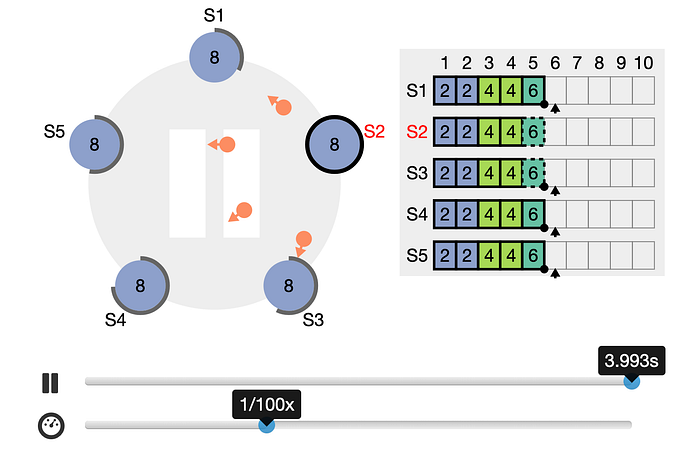
In Raft, nodes can assume one of three roles: leader, follower, or candidate. MongoDB maps these roles to its architecture seamlessly. The primary node functions as the leader, handling all client write operations and coordinating replication. The secondaries serve as followers, maintaining copies of the primary’s data. A node transitions to the candidate role during an election, triggered by leader unavailability.
Elections begin when a follower detects a lack of heartbeats from the leader for a configurable timeout period. The follower promotes itself to a candidate and sends RequestVote messages to all other members. A majority of votes is required to win. Votes are granted only if the candidate’s log is at least as complete as the voter’s log, based on the term and index of the most recent log entry. If multiple candidates emerge, Raft resolves contention through randomized election timeouts, reducing the likelihood of split votes. Once a leader is elected, it begins broadcasting heartbeats (AppendEntries RPCs) to assert its leadership.
Log Replication: Ensuring Consistency
MongoDB’s replication mechanism revolves around the oplog, an append-only log that stores all write operations executed on the primary. In Raft terms, the oplog acts as the distributed log, ensuring all nodes maintain identical sequences of operations.
When a write operation is initiated, the primary appends the operation to its oplog and propagates it to followers via AppendEntries. Each log entry contains:
- Term Number: Reflecting the election term during which the entry was created.
- Log Index: The entry’s position in the oplog.
- Operation Details: The write operation to be applied to the database.
Followers append these entries to their oplog and acknowledge their receipt. To maintain Raft’s log matching property, if a follower detects a gap in its oplog, the primary backtracks to the last matching entry and retransmits the missing entries. This ensures that all nodes converge to the same state, even after temporary failures or delays.
Commitment and Durability in MongoDB
Raft introduces the concept of a commit index, which marks the highest log entry replicated to a majority of nodes. MongoDB uses this commit index to ensure durability:
- A write operation is only considered committed when it is acknowledged by a majority of nodes.
- Committed operations are applied to the database and become visible to clients.
MongoDB enhances this process with configurable write concerns. For instance, w: majority ensures a write is acknowledged only after replication to a majority, providing strong guarantees against data loss. This is particularly critical in environments with stringent durability requirements.
Failure Handling and Recovery
Failures are inevitable in distributed systems, and Raft’s design enables MongoDB to handle them with resilience. When a leader fails, followers detect the absence of heartbeats and initiate a new election. A new leader is typically elected within seconds, minimizing downtime for write operations.
MongoDB prevents split-brain scenarios by ensuring only partitions with a majority of voting members can elect a leader. Minority partitions remain read-only, preserving data consistency. Nodes that fall behind due to temporary failures recover by replaying oplog entries from the leader. If the oplog window is insufficient, a full resynchronization is required, but MongoDB optimizes this process to reduce downtime.
MongoDB-Specific Optimizations in Raft
MongoDB adapts Raft for database-specific workloads, incorporating several optimizations:
- Asynchronous Replication: Followers acknowledge log entries before applying them, reducing replication latency and improving write throughput.
- Dynamic Heartbeats: MongoDB adjusts heartbeat intervals based on network conditions, reducing overhead without compromising responsiveness.
- Stale Read Prevention: Secondaries only serve data reflecting the leader’s commit index, ensuring consistent reads.
- Efficient Conflict Resolution: MongoDB backtracks logs only to the necessary point, avoiding redundant retransmissions and minimizing recovery time.
Consistency Levels with Raft
Raft’s strong consistency guarantees are reflected in MongoDB’s read concerns. For example:
readConcern: localallows immediate reads from the primary without waiting for majority acknowledgment, optimizing latency.readConcern: majorityensures that clients see only committed data, providing a consistent view of the database state.
These options give applications the flexibility to balance latency and consistency based on their needs.
Raft vs. Paxos: Why Chose Raft
While Paxos is the foundation of many consensus protocols, Raft offers simplicity without compromising correctness. Its clear division of responsibilities — leader election, log replication, and commitment — makes it easier to implement and debug. MongoDB’s enhancements further tailor Raft to the challenges of database replication, making it a natural fit for its replica set architecture.
Conclusion
MongoDB’s adoption of Raft underpins its ability to deliver reliable, scalable, and consistent replication. By leveraging Raft’s structured consensus protocol and extending it with database-specific optimizations, MongoDB achieves a replication system that is robust against failures and adaptable to diverse application requirements.
- February 24, 2026
- 3 min read

Engineering Manager @ Netways












Comments (0)
No comments yet. Be the first.