

A Visual Diff of Java’s Evolution: Inside java.evolved
- February 20, 2026
- 2 min read
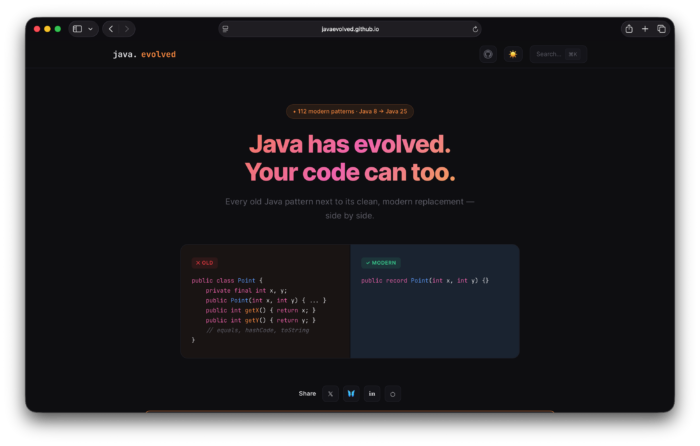
A community project called java.evolved was recently launched to document how common Java coding patterns have changed across releases. Instead of explaining features in isolation, the site presents “before and after” examples: traditional idioms next to modern alternatives.
The approach targets a practical problem. Most developers work in mixed-era codebases where Java 6, 8, and 17 styles coexist. Rather than memorizing new language features, the site shows what existing code would look like if written today.
Less Boilerplate, More Intent
One example contrasts a classic data class with a record.
Before
public class User {
    private final String name;
    private final int age;

    public User(String name, int age) {
        this.name = name;
        this.age = age;
    }

    public String getName() { return name; }
    public int getAge() { return age; }
}
After
public record User(String name, int age) {}
The goal is not a new capability but a clearer expression. Modern Java often removes ceremony around concepts that already existed.
Safer Type Handling and Control Flow
The site also shows improvements in type checks and switch logic.
Pattern matching
if (obj instanceof String s) {
    System.out.println(s.length());
}
Switch expression
int letters = switch (day) {
    case MONDAY, FRIDAY, SUNDAY -> 6;
    case TUESDAY -> 7;
    default -> 0;
};
These changes shift common runtime mistakes into compile-time guarantees.
Why It Matters
Java’s evolution has been gradual, making improvements easy to miss. Seen individually, features look incremental. Seen side by side, they show a significant shift toward readability and correctness.
Community reactions suggest a clear use case: onboarding developers and guiding code reviews in mature systems. Rather than debating style, teams can reference concrete transformations.
Community Perspective
In a short exchange about the motivation behind the project, Bruno Borges explained that the gap is largely about awareness rather than resistance to change:
“As Java developers find themselves being able to use newer versions of the JDK, I believe they do start adopting new language idioms, but new API usage requires deeper thinking and learning. Then, there is also the element of non-Java developers having the misconception that Java today is still the same as Java from more than a decade ago. The website helps bring awareness to both cases!”
This perspective aligns with the project’s goal: not convincing developers to abandon existing code, but giving them a concrete reference point for how the language has evolved.
Conclusion
java.evolved acts as a translation layer between past and present Java. By framing language features as recognizable rewrites instead of abstract concepts, it helps developers answer a simple daily question:
“How would we write this today?”
- February 20, 2026
- 2 min read

A N M Bazlur Rahman is a Software Engineer with over a decade of specialized experience in Java and related technologies. His expertise has been formally recognized through the prestigious title of Java Champion. Beyond his professional commitments, Mr. Rahman is deeply involved in community outreach and education. He is the founder and current moderator of the Java User Group in Bangladesh, where he has organized educational meetups and conferences since 2013. He was named Most Valuable Blogger (MVP) at DZone, one of the most recognized technology publishers in the world. Besides DZone, he is an editor for the Java Queue at InfoQ, another leading technology content publisher and conference organizer, and an editor at Foojay.io, a place for friends of OpenJDK. In addition, he has published five books about the Java programming language in Bengali; they were bestsellers in Bangladesh. He earned his bachelor's degree from the Institute of Information Technology, University of Dhaka, Bangladesh, in Information Technology, majoring in Software Engineering. He currently lives in Toronto, Canada.













Comments (0)
No comments yet. Be the first.